

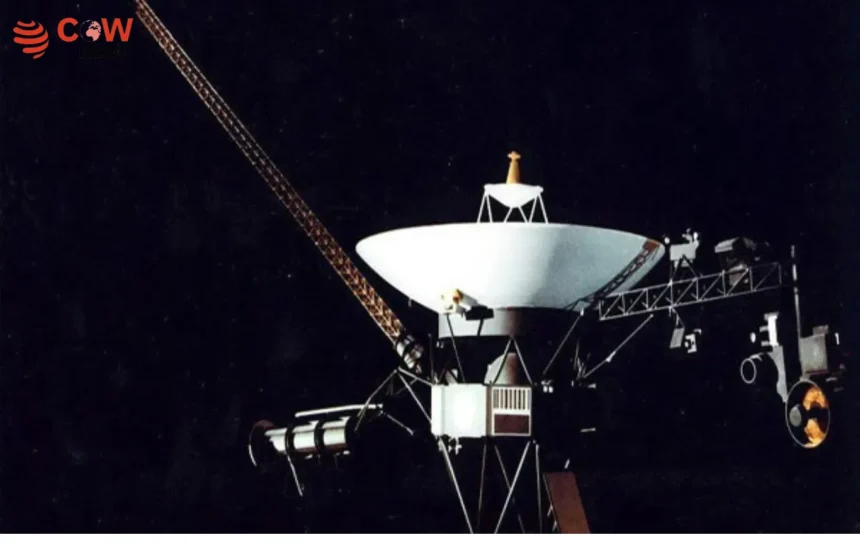
Washington (The COW News Digital) NASA’s Voyager 1 spacecraft has achieved another extraordinary milestone in space exploration, reaching a distance from Earth equivalent to one light-day. The historic achievement highlights the remarkable journey of humanity’s most distant spacecraft, which has been travelling through space for nearly five decades.
at exactly 10:16:07 GMT. At this distance, a signal travelling at the speed of light takes approximately 24 hours to reach Earth from the spacecraft.
A light-day represents the distance that light travels through space in 24 hours. Given that light moves at approximately 186,000 miles per second, one light-day is equivalent to around 16 billion miles, or 26 billion kilometres.
The achievement provides a remarkable perspective on the scale of Voyager 1’s journey. In April 2026, astronauts participating in NASA’s Artemis II mission reportedly travelled 252,756 miles from Earth, establishing a new record for human spaceflight. Voyager 1 is now more than 63,000 times farther from Earth than that distance.
NASA launched Voyager 1 on September 5, 1977, as part of its ambitious programme to investigate the outer planets of the Solar System.
The mission took advantage of an unusually favourable alignment of the outer planets, an astronomical configuration that occurs approximately once every 175 years. This rare opportunity allowed spacecraft to use the gravitational forces of planets to accelerate and redirect their journeys.
Using this technique, Voyager 1 travelled past Jupiter and Saturn, collecting valuable scientific information and transmitting extraordinary images back to Earth.
Its observations significantly expanded scientific understanding of the giant planets, their atmospheres, magnetic environments and natural satellites. The spacecraft also provided important insights into Saturn’s rings and Jupiter’s volcanic moon Io.
One of Voyager 1’s most significant achievements came in August 2012, when it crossed the heliopause and entered interstellar space.
The heliopause marks the boundary where the solar wind from the Sun is no longer dominant over the surrounding interstellar environment. Voyager 1 consequently became the first human-made spacecraft to enter interstellar space.
Since then, it has continued travelling farther from the Sun, collecting scientific measurements about the environment beyond the traditional boundaries of the Solar System.
However, operating a spacecraft over such an enormous distance presents considerable challenges. Its ageing technology, limited electrical power and increasingly difficult communication conditions require NASA engineers to carefully manage its remaining systems.
The one-light-day milestone has a particularly important consequence for communication between Earth and Voyager 1.
A radio signal sent from the spacecraft now takes approximately 24 hours to reach Earth. Similarly, a command transmitted from mission control requires approximately the same amount of time to arrive.
This means a complete exchange involving a command and a response takes roughly 48 hours, excluding processing and operational delays.
Despite these challenges, Voyager 1 remains one of the most extraordinary achievements in the history of space exploration.
Its journey, which began in 1977, continues to demonstrate the power of scientific ambition and engineering. Carrying the famous Golden Record, containing sounds, images and greetings from Earth, Voyager 1 remains a symbolic ambassador of humanity as it travels deeper into interstellar space.
The spacecraft’s latest milestone serves as a powerful reminder of how far human exploration has reached beyond our planet.