

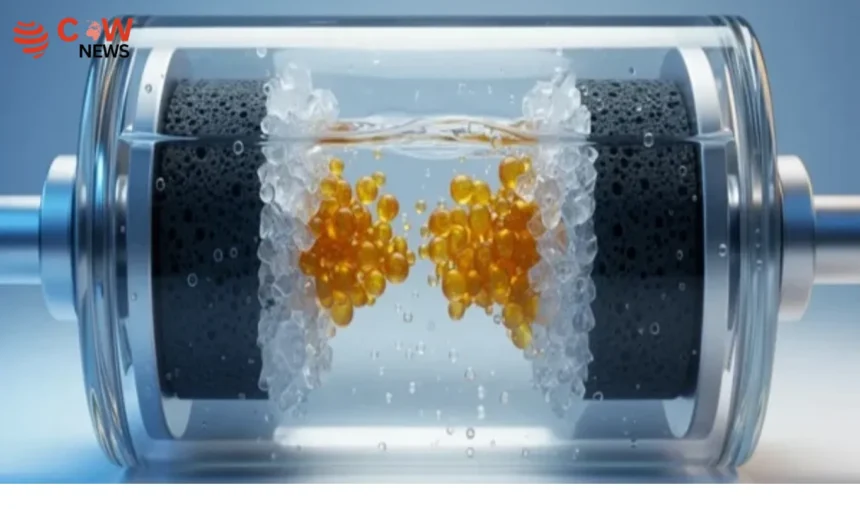
LONDON (The COW News Digital) Scientists have made a significant breakthrough in aqueous battery technology, potentially opening new possibilities for safer, more sustainable and efficient large-scale energy storage systems.
The research, published in the prestigious scientific journal Nature, could help overcome one of the biggest limitations of water-based batteries: their relatively low energy storage capacity.
Large-scale energy storage facilities, commonly known as battery farms, are considered essential for achieving net-zero carbon emission targets. These systems store surplus electricity generated from renewable sources such as solar and wind power, making it available when sunlight is unavailable or wind conditions are insufficient.
Currently, lithium-ion batteries dominate the energy storage market. However, concerns remain over their fire risks and the environmental consequences of extracting limited natural resources such as cobalt.
Aqueous batteries, which use water-based electrolytes, are emerging as a potentially safer and more environmentally friendly alternative. However, their limited ability to store energy has restricted their widespread commercial application.
The new research, led by a team from University College London (UCL), aims to address this challenge by significantly improving the energy storage capacity of iodine, a key material used in these batteries.
Researchers developed a method that enables iodine to transfer four electrons instead of the conventional two during charging and discharging. This process increases the amount of energy that can potentially be stored within the battery.
A major challenge has been controlling the highly reactive chemical behaviour of hypervalent iodine cations (I+), which react rapidly in water. Previous approaches relied on highly concentrated halogen-based electrolytes to prevent unwanted chemical reactions.
However, these electrolytes can be corrosive, expensive and difficult to manufacture on an industrial scale.
The UCL-led research team developed a new electrolyte formulation that stabilises iodine without relying on corrosive materials. The approach modifies the molecular environment surrounding iodine, with certain molecules limiting water’s access while others bind to reactive iodine species to keep them stable.
Researchers also demonstrated that the new battery design could operate reliably in different cell configurations, including pouch cells and coin cells.
Testing further showed that zinc-iodine batteries retained almost all their energy storage capacity after thousands of charging and discharging cycles, highlighting their potential durability.
The scientists believe the technology could also be adapted for aluminium-iodine batteries, potentially expanding its applications across different energy storage systems.
Although further development and commercial testing will be necessary, the breakthrough could contribute to the development of safer and more sustainable batteries for renewable energy storage in the future.