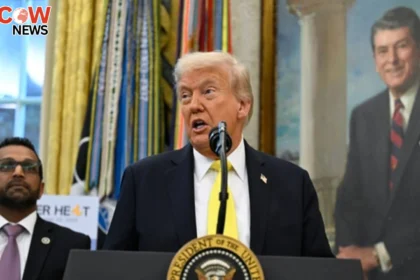


WASHINGTON (The COW News Digital ) US President Donald Trump has predicted a sharp decline in oil and gasoline prices following what he described as a US victory in the war with Iran.
In a statement posted on his social media platform, Truth Social, Trump said oil prices would fall “very rapidly” once the conflict comes to an end. He suggested that gasoline prices for American consumers could drop to around $3 per gallon, with prices potentially falling below $2 per gallon eventually.
Trump also reiterated that Iran would not be allowed to acquire nuclear weapons, linking the outcome of the conflict to Washington’s broader security objectives in the region.
The president’s remarks come as international energy markets remain under significant pressure because of the ongoing conflict and heightened tensions surrounding the Strait of Hormuz, a crucial route for global oil shipments.
Oil prices have risen amid concerns over possible disruptions to crude supplies. Recent market movements have reflected growing uncertainty among traders over the security of energy shipments through the region.
According to the Financial Times, Brent crude prices have recently moved close to $98 per barrel, highlighting the impact that geopolitical tensions are having on the global energy market.
The Strait of Hormuz is particularly important to international oil markets because a significant volume of global energy supplies passes through the strategic waterway. Any prolonged disruption could put additional upward pressure on crude prices and increase costs for consumers and businesses worldwide.
Trump, however, expressed confidence that oil markets would quickly stabilize once the war ends. His forecast suggests that the restoration of normal supply conditions could ease pressure on crude prices and eventually reduce gasoline costs in the United States.
Nevertheless, the prediction that US gasoline prices could fall below $2 per gallon remains a political forecast rather than a guaranteed market outcome. Actual prices will depend on several factors, including global crude production, supply routes, refinery capacity, demand and the duration and outcome of the conflict.
Analysts generally view geopolitical stability as an important factor for energy markets, particularly when major oil-producing regions and critical shipping routes are involved.
For now, uncertainty surrounding Iran, the Strait of Hormuz and global oil supplies continues to influence crude prices. Whether Trump’s forecast materializes will largely depend on how quickly the conflict ends and how international energy markets respond afterward.