
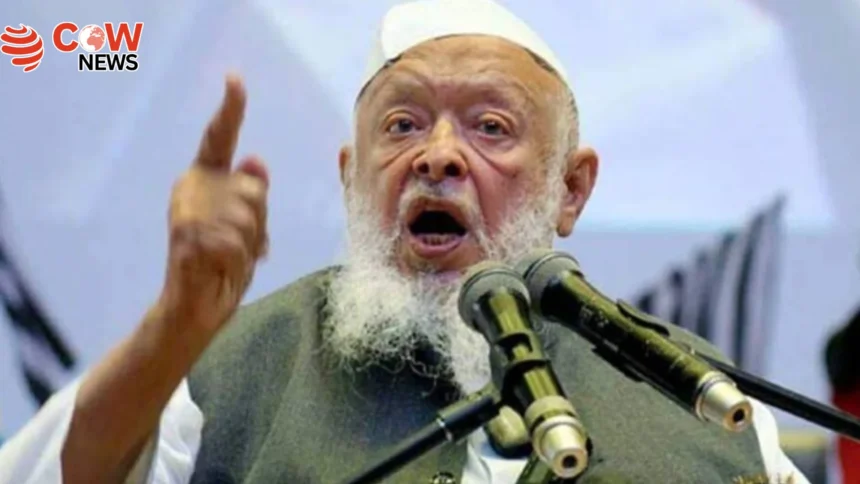
India(The COW News Digital)Maulana Arshad Madani, President of Jamiat Ulama-e-Hind (Arshad faction) and senior scholar at Darul Uloom Deoband, has reiterated that the slogan Vande Mataram carries meanings that contradict the core beliefs of Islam. In a statement released on social media, he clarified that while Muslims have no objection to others reciting or singing the national song, they themselves cannot participate because it contains expressions that conflict with the Islamic concept of monotheism.
Madani emphasized that Islam teaches the worship of only one God, and Muslims cannot associate anyone else in this worship. According to him, several stanzas of Vande Mataram include language that attributes divine status to the nation, comparing it to the Hindu goddess Durga and invoking terms of devotion and worship toward it. These aspects, he said, are incompatible with the fundamental tenets of a Muslim’s faith.
Read More:
- Trump Threatens Kabul Over Bagram Airbase Control
- US Slams Palestine Recognition as Empty Symbolism
He added that the issue is not about patriotism, as love for one’s country is natural and accepted in Islam. The distinction, he stressed, lies between patriotic affection and worship. “Patriotism is different; worship is something else. Indian Muslims do not need anyone’s certificate to prove their love for the country,” he said. Madani further asserted that the Indian Constitution protects citizens from being compelled to embrace slogans, songs or ideologies that go against their religious convictions.
The scholar referenced previous controversies in which Muslim councillors or students faced consequences for declining to recite the national song. He argued that such incidents reflect a misunderstanding of both Islamic principles and constitutional rights. Madani maintained that Muslims respect national symbols but cannot participate in practices they believe contradict their faith.
Quoting the full meaning of Vande Mataram, he noted that the translation clearly includes phrases such as “Mother, I worship you,” which he said indicate that the poem—originally written in praise of the goddess Durga—cannot be regarded as a purely patriotic composition. He insisted that the theological implications of these phrases make participation impossible for Muslims who strictly uphold monotheism.
Madani’s remarks come amid renewed national debate around the recitation of Vande Mataram, with some political groups pressuring public representatives and institutions to adopt it. His statement seeks to reaffirm the community’s long-standing position while calling for mutual respect and constitutional adherence in a pluralistic society.