
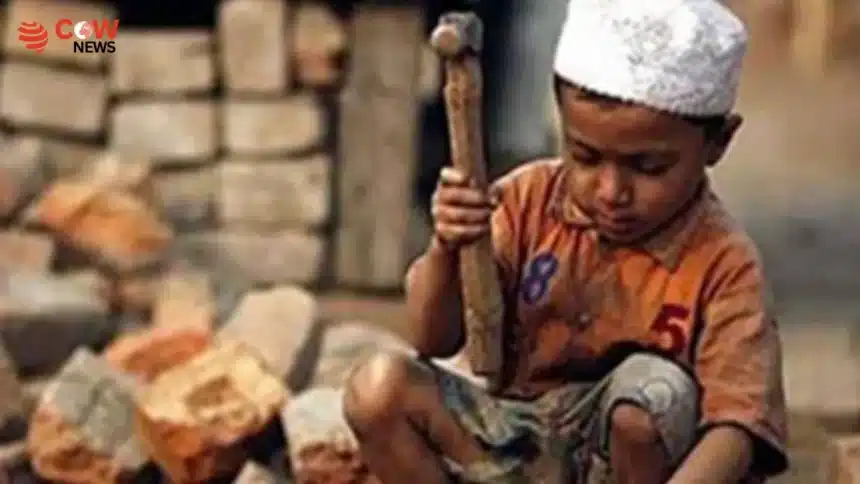
World ( The cow news digital ) A new national report released by the National Commission for Human Rights (NCHR) in collaboration with UNICEF has revealed that an estimated 8.6 million children in Pakistan are engaged in child labour, with more than 6.6 million involved in hazardous work that poses serious risks to their health, safety, and future.
The report, titled “Pakistan: Child Labour Surveys – Evidence for Action,” provides one of the first comprehensive national data sets on child labour in nearly three decades. It presents a detailed picture of the scale, distribution, sectors, and underlying causes of child labour across the country.
According to the findings, Punjab bears the highest burden with around 6 million working children, followed by Sindh with 1.6 million, Khyber Pakhtunkhwa with over 745,000, and Balochistan with approximately 201,000 children engaged in labour. In Islamabad Capital Territory, around 15,000 children were recorded working.
Officials highlighted poverty as the primary driver of child labour, with higher prevalence among low-income households and families with limited access to education. The report also notes a significant gender disparity, with boys more likely than girls to be engaged in labour, particularly in hazardous occupations.
A large proportion of child labour is reported to take place within family settings, including farms, workshops, and household-based work. Experts say this informal nature of work makes it difficult to detect and regulate through conventional labour inspection systems.
The report further warns of severe consequences for children involved in labour. Many are deprived of education, work long hours, and face frequent injuries, illnesses, fatigue, and mental health challenges. In several provinces, between 32% and 58% of working children reported work-related injuries or illness, while a significant share of older working children showed signs of depression.
Federal Minister for Law and Human Rights Azam Nazeer Tarar said the issue cannot be addressed through isolated efforts and requires coordinated policy action, legislative reforms, and sustained political commitment.
Supreme Court Justice Ayesha Malik emphasized that Pakistan has clear constitutional obligations under Article 11, which prohibits child labour under the age of 14 in hazardous work, and Article 25A, which guarantees free and compulsory education.
UNICEF representative Pernille Ironside stressed the importance of translating data into action, urging stronger investments in education and poverty reduction to protect children from exploitation.
Experts and child rights advocates at the event called for immediate implementation of evidence-based policies to reduce child labour and ensure that every child remains in school and safe from exploitation.