
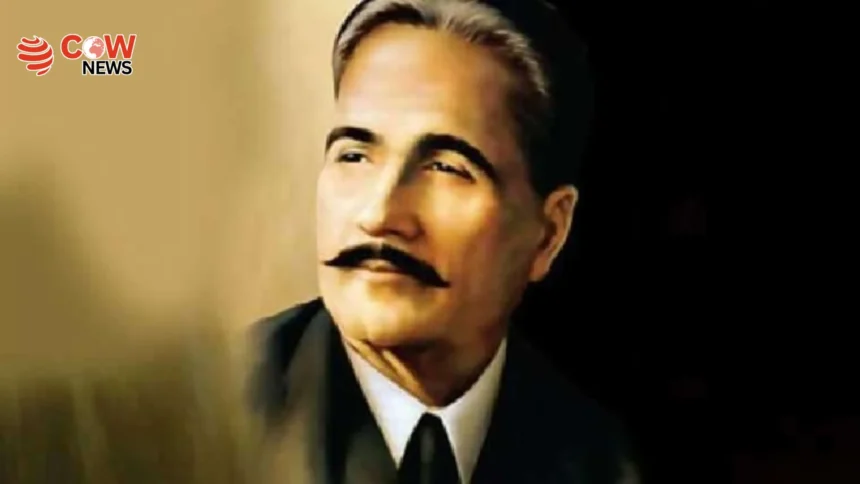
National ( The cow news digital ) Pakistan is observing the 88th death anniversary of renowned philosopher, poet, and national thinker Allama Muhammad Iqbal, widely regarded as the “Poet of the East.” Tributes are being paid across the country to honor his intellectual contributions, literary legacy, and vision for a separate homeland for Muslims of the Indian subcontinent.
Allama Iqbal is remembered as a key ideological figure behind the creation of Pakistan. His poetry and philosophical ideas played a crucial role in awakening political and social consciousness among Muslims during the British colonial era. His vision inspired a sense of unity, identity, and purpose that later became the foundation of the Pakistan Movement.
Born on November 9, 1877, in Sialkot, Iqbal began his early education in his hometown. He completed his matriculation from Mission High School and later obtained his intermediate education from Murray College Sialkot. He went on to study at Government College Lahore, where he completed a master’s degree in philosophy.
For higher studies, Allama Iqbal traveled to Europe. He studied law in England and later pursued doctoral studies in Germany, earning a PhD in philosophy from the University of Munich. After completing his education, he briefly served as a lecturer at Oriental College Lahore before practicing law as a profession.
Despite his legal career, Iqbal remained deeply engaged in poetry and intellectual discourse. He actively participated in political and social discussions of his time and was awarded the title of “Sir” by the British government in 1922.
His literary works, including Bang-e-Dra, Bal-e-Jibril, Zarb-e-Kalim, and Armaghan-e-Hijaz, continue to be widely studied and appreciated for their philosophical depth and spiritual insight. His famous Allahabad Address of 1930 is considered a historic milestone in articulating the idea of a separate Muslim state.
READ MORE
- US Envoy Backs Israel’s Claim to Wider Middle East
- Pakistan, Taliban, and Afghanistan: The Complex Triangle of Influence
Allama Iqbal passed away on April 21, 1938, before witnessing the creation of Pakistan. However, his vision was realized in 1947 when Pakistan emerged as an independent state under the leadership of Quaid-e-Azam Muhammad Ali Jinnah.
His mausoleum, located near the Badshahi Mosque in Lahore, remains a national symbol and a place of tribute for admirers. Today, the nation honors his legacy and reflects on his message of self-awareness, unity, and intellectual awakening.