

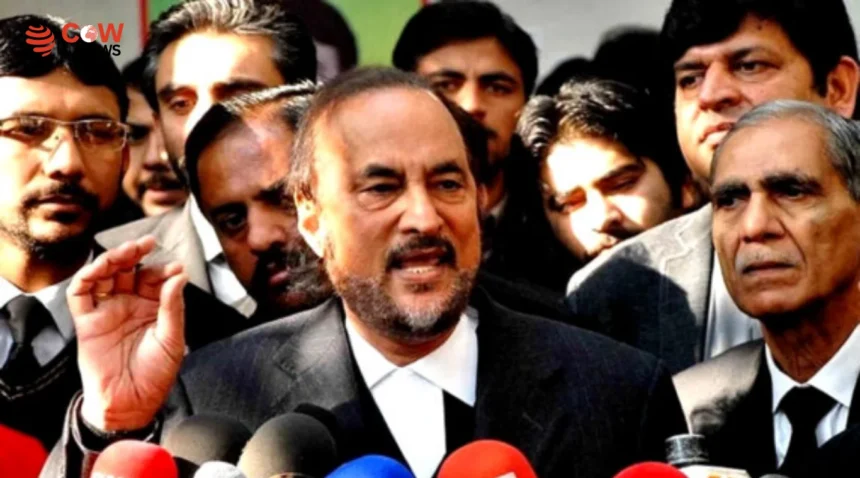
Islamabad (The COW News Digital)Former federal minister and constitutional lawyer Dr Babar Awan has raised questions over the possible imposition of governor’s rule or an emergency in Khyber Pakhtunkhwa, saying that if such an extraordinary constitutional step is taken in one province, similar questions could arise about its possible application elsewhere, including Sindh.
Speaking amid growing debate over the federal government’s options in Khyber Pakhtunkhwa, Awan questioned whether the president could impose an emergency in a province without following the constitutional procedure and required safeguards.
His remarks come as the federal government considers possible action in Khyber Pakhtunkhwa amid concerns over security and law and order. Federal Parliamentary Affairs Minister Tariq Fazal Chaudhry said on September 30 that the government was seriously considering an emergency under Article 232, citing the security situation in the province.
Awan specifically highlighted Article 232 of the Constitution, which deals with the proclamation of an emergency in circumstances including war, external aggression or internal disturbance beyond the control of a provincial government.
Under the current constitutional text, when an emergency is proposed on the basis of internal disturbance beyond the provincial government’s ability to control, a resolution from the relevant provincial assembly is required. The Constitution further provides that if the president acts on his own, the proclamation must be placed before both houses of Parliament for approval within 10 days.
The constitutional lawyer also stressed the distinction between an emergency under Article 232 and governor’s rule under Article 234. The two provisions address different constitutional circumstances and involve different procedures.
Article 234 concerns a situation in which the government of a province cannot be carried on in accordance with the Constitution. In such circumstances, the president may take constitutional measures after receiving a report from the governor, subject to the conditions laid down in the Constitution.
Awan’s comments come against the backdrop of heightened political tensions between the federal government and the PTI-led provincial administration in Khyber Pakhtunkhwa. The federal government has linked discussions over possible emergency measures to the province’s security situation, while PTI leaders have opposed any such move.
The debate has also intensified ahead of PTI’s announced October 4 march towards Islamabad. Prime Minister Shehbaz Sharif is meanwhile consulting coalition partners over the political and security situation surrounding Khyber Pakhtunkhwa.
Federal Law Minister Azam Nazeer Tarar has said that any decision concerning governor’s rule or an emergency would have to meet the constitutional and legal requirements. He has also said that the relevant constitutional process would determine whether such action could be taken.
Awan’s central argument is therefore focused on constitutional procedure rather than simply the political decision to impose extraordinary measures. He questioned whether an emergency could be declared through a decision taken behind closed doors or whether the constitutional requirements and parliamentary safeguards must first be fulfilled.
As discussions continue, the precise legal route available to the federal government, the role of the president and governor, and the constitutional requirements for any emergency or governor’s rule remain central to the debate.
The situation is developing, with political parties and government officials continuing to present differing views on the constitutional and legal implications of any possible action in Khyber Pakhtunkhwa.