

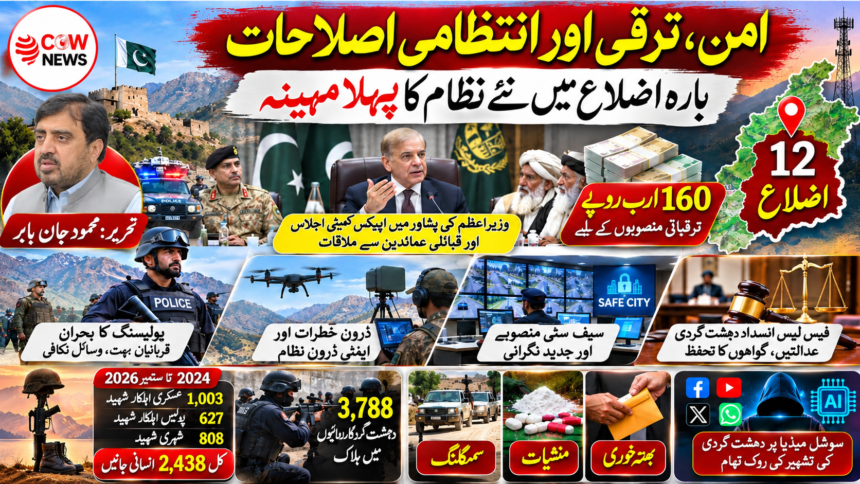
Peshawar (The COW News Digital) One month after the introduction of a new administrative framework across 12 districts of Khyber Pakhtunkhwa, questions are emerging over what has changed on the ground and whether the initiative can deliver lasting improvements in security, governance and public services.
The first month has brought institutional arrangements, new financial priorities and a renewed focus on coordination between local communities and government authorities. However, translating these decisions into visible improvements in people’s daily lives remains the biggest challenge.
The distinction between setting up an administrative structure, allocating financial resources and delivering practical results is particularly important in regions that have endured years of militancy, displacement, weak governance and limited development opportunities.
One of the early steps was the formation of Area Representative and Development Councils, bringing tribal elders and local representatives into the process of identifying regional needs and development priorities.
On October 22, Prime Minister Shehbaz Sharif visited Peshawar and chaired a meeting of the federal Apex Committee. He also met separately with elders and council members from the 12 districts, giving local representatives an opportunity to present their concerns directly to senior federal decision-makers.
During the visit, the prime minister announced Rs160 billion for development projects in Khyber Pakhtunkhwa. The announcement was viewed as an important financial commitment, although the effectiveness of the allocation will ultimately depend on its implementation and the delivery of projects.
Improving policing remains one of the most pressing issues in the province, particularly in the former tribal districts, where law enforcement personnel have faced increasingly complex security threats.
Many Levies and Khassadar personnel have had to adapt to modern policing requirements, including advanced investigation methods, digital systems and new forms of militant attacks. At the same time, militant groups have increasingly used technologies such as night-vision equipment, thermal devices and drones.

This has created a serious imbalance between the capabilities available to security personnel and the threats they are expected to counter.
According to a government security briefing presented in November 2026, the provincial police force was facing a shortage of more than 10,000 personnel. The briefing also identified gaps in operational vehicles, modern equipment and protection against drone attacks.
The financial proposals outlined in the briefing indicate a significant planned increase in security spending. Around Rs98 billion was reportedly spent on the security sector over the previous decade, while a proposed annual allocation of approximately Rs70 billion has been outlined for the police and Counter Terrorism Department.
Of the proposed amount, Rs59.8 billion is earmarked for the police and Rs10.3 billion for the CTD.
However, comparing expenditure over ten years with a proposed allocation for a single year requires caution. Inflation, differences in budget coverage and the distinction between proposed and actual spending must also be considered.
The new security planning places considerable emphasis on strengthening surveillance and improving the ability of police forces to respond to emerging threats.
The proposed targets include increasing police surveillance capacity from 15 per cent to 60 per cent, improving protection against aerial threats and strengthening counter-drone capabilities.
Sensitive districts such as Dera Ismail Khan, Bannu and Lakki Marwat have been identified for measures involving anti-drone systems, Safe City projects and improved communication facilities.
The plans also recognise the need for specialised training, protective vehicles, modern equipment and additional recruitment.
The growing use of technology by militant groups has made intelligence gathering, surveillance and rapid response increasingly important components of counterterrorism operations.
The human losses recorded in the province underline the urgency of improving security.
According to the government briefing, 1,003 military personnel, 627 police officers and 808 civilians were killed in terrorism-related incidents between 2024 and September 2026. The combined death toll stands at 2,438.
The same briefing reported that security forces had killed 3,788 militants during operations over the past three years.
However, the success of a security strategy cannot be measured solely by the number of operations conducted or militants killed. A meaningful improvement would be reflected in fewer civilian and police casualties, safer markets, uninterrupted education and greater freedom of movement for ordinary people.
Another important element of the proposed strategy concerns the judicial process in terrorism cases.
The security briefing highlighted the risks faced by witnesses, prosecutors and judges involved in sensitive cases. Threats against these individuals can undermine investigations, weaken prosecutions and delay justice.
To address these concerns, legal amendments have been proposed to facilitate the establishment of faceless Anti-Terrorism Courts. The proposed arrangements aim to introduce protective procedures for witnesses, judges and prosecutors, including measures to safeguard their identities.
The effectiveness of such a system will depend on its legal framework, implementation and ability to ensure both security and fair judicial proceedings.
The new planning also focuses on the financial networks that can support criminal and militant activities.
Smuggling, narcotics trafficking, extortion and the illegal movement of non-custom-paid vehicles have been identified as areas requiring greater attention.
The broader objective is to address not only armed groups but also the financial channels and criminal networks that may facilitate their activities.
Authorities are also considering the use of digital and artificial intelligence-based tools to counter online incitement, the promotion of violence and terrorist propaganda on social media.
The inclusion of tribal elders and local representatives in development planning is among the most significant features of the new administrative framework.
In areas that have experienced prolonged insecurity and economic deprivation, public confidence cannot be restored through official announcements alone. People need to see that their concerns are heard, their priorities influence government decisions and institutions remain accountable to local communities.
The Area Representative and Development Councils could provide a channel for that engagement, provided they are given meaningful responsibilities and their recommendations lead to practical action.
The first month has not brought a complete transformation to the 12 districts. It has, however, introduced a new administrative arrangement, outlined financial priorities and brought security, development and local participation into a broader framework.
The coming months will determine whether these measures move beyond meetings, announcements and official documents to produce tangible results.
For residents of the 12 districts, the real measure of success will be straightforward: Are their children safer? Have public services improved? Can people travel, work and run businesses without fear? And is the state responding to their needs more effectively?
These are the questions that will ultimately determine the success of the new system.
The writer, Mahmood Jan Babar, is a senior journalist and currently serves as an information adviser for the 12 designated districts of Khyber Pakhtunkhwa.