

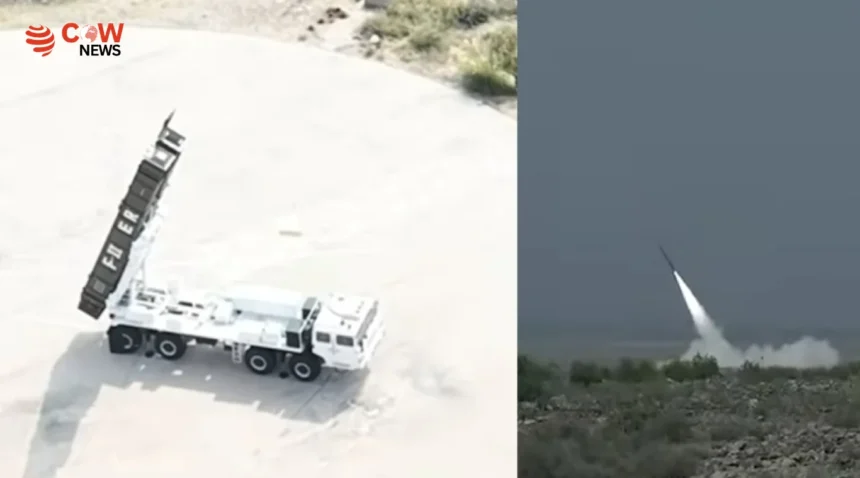
ISLAMABAD (The COW News Digital) The Pakistan Army has successfully tested its Fatah-II Extended Range (ER) missile system, according to a statement issued by the Inter-Services Public Relations (ISPR).
The military’s media wing said the missile is equipped with an advanced navigation system and state-of-the-art avionics, enabling it to alter its flight path and direction while in flight.
According to the ISPR, the system is designed to engage designated targets with high precision and has capabilities intended to challenge opposing missile defence systems.
The extended range is expected to increase the Pakistan Army’s operational reach and strengthen its ability to engage targets located at greater distances.
The military statement did not specify the exact range of the missile, the location of the test or other technical details concerning the trial.
The ISPR highlighted the missile’s navigation and avionics systems as key features of its design. Its reported ability to change course during flight is intended to provide greater flexibility in reaching designated targets.
The military also stated that the system could complicate interception efforts by opposing missile defence networks. However, the effectiveness of such capabilities would depend on operational conditions and the performance of the relevant defence systems.
The successful test represents a development in Pakistan’s efforts to expand the range and capabilities of its missile systems, according to the military.
The test was witnessed by the Commander of the Army Rocket Force Command, senior Pakistan Army officers, and scientists and engineers involved in the missile programme.
Following the trial, the commander praised the scientists and engineers for their dedication and technical expertise, the ISPR said.
The statement also confirmed that the president, prime minister, chief of defence forces and service chiefs congratulated the scientists and engineers on the reported success.
Their messages of congratulations recognised the contribution of the technical teams involved in the development and testing of the system.
The development comes as regional security considerations continue to shape defence planning across South Asia. Missile range, accuracy, navigation and the ability to overcome defensive systems are important factors in the assessment of modern military capabilities.
An extended-range system can potentially provide armed forces with greater flexibility in planning operations. However, the broader strategic implications of the Fatah-II ER will depend on its verified technical specifications, operational status and integration into Pakistan’s overall defence structure.
The ISPR announcement did not provide independent assessment data or detailed performance measurements from the test.
Further information regarding the missile’s precise range, operational deployment and performance under different conditions was not included in the statement.
For now, the Pakistan Army has described the test as successful, highlighting the system’s reported navigation capabilities and extended operational reach as important features of the missile programme.