
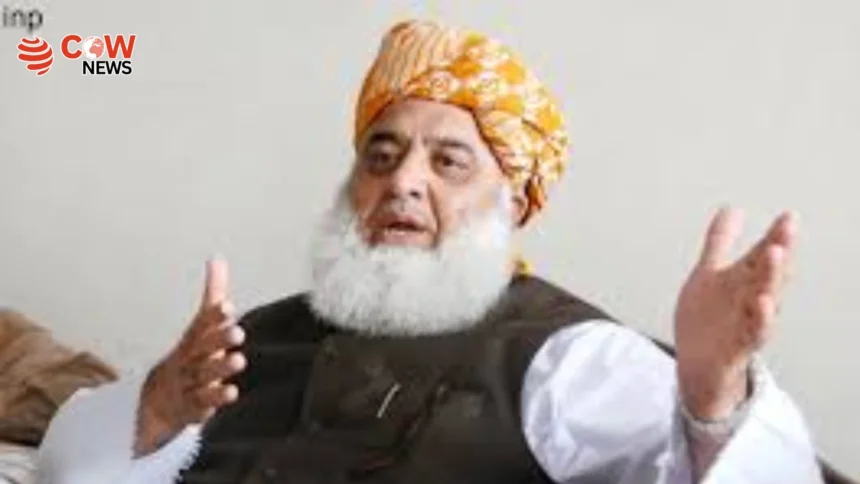
National ( The cow news digital ) Jamiat Ulema-e-Islam (F) chief Maulana Fazlur Rehman has advised former U.S. President Donald Trump to learn the etiquette of dialogue, criticizing his communication style during a recent public address in Pakistan.
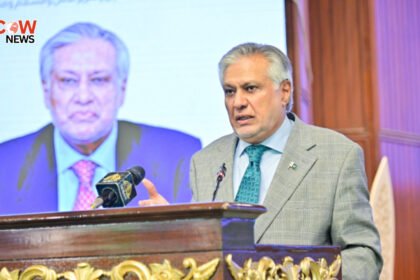
Speaking at a condolence reference held in memory of renowned poet Syed Salman Gilani, organized under JUI-F Punjab, Fazlur Rehman expressed concern over what he described as inappropriate rhetoric in international political discourse. The event was attended by several political and religious leaders, including Pakistan Muslim League-Nawaz (PML-N) leader Khawaja Saad Rafique, Jamaat-e-Islami deputy chief Liaquat Baloch, JUI-F General Secretary Maulana Abdul Ghafoor Haideri, and other prominent scholars.
During his speech, the JUI-F leader remarked that the tone used by the U.S. president was so harsh that “even a local street criminal does not speak in such a manner,” urging him to first understand the principles of respectful dialogue and negotiation. He emphasized that diplomacy requires restraint and adherence to established norms of communication.
Fazlur Rehman further stated that Pakistan’s role in mediating international tensions reflects its capability to contribute positively to global peace efforts. He argued that such diplomatic engagement helps prevent larger conflicts, including the possibility of a broader regional or global war.
He also clarified that protests against inflation had been postponed on the instructions of political leadership, stressing that this was not a cancellation but a temporary deferment in light of national considerations.
Criticizing inconsistent foreign policy messaging, he pointed out that engaging in negotiations while simultaneously issuing threats undermines the credibility of diplomatic efforts. He suggested that such contradictions weaken the prospects for meaningful dialogue in international relations.
read more
- Imran Khan and the Politics of Idolization
- Pakistan, Taliban, and Afghanistan: The Complex Triangle of Influence
Other speakers at the event also shared their perspectives on Pakistan’s political and strategic role. Khawaja Saad Rafique described JUI-F as an important “defensive line” for the country, questioning why the state had not fully utilized its potential in national affairs. He also remarked that Pakistan’s military capability had drawn global attention, particularly in the context of shifting international power dynamics.
The gathering highlighted broader discussions on Pakistan’s domestic political environment as well as its evolving role in regional and global diplomacy. Analysts note that such statements reflect ongoing debates within the country regarding foreign policy direction and engagement with major world powers.