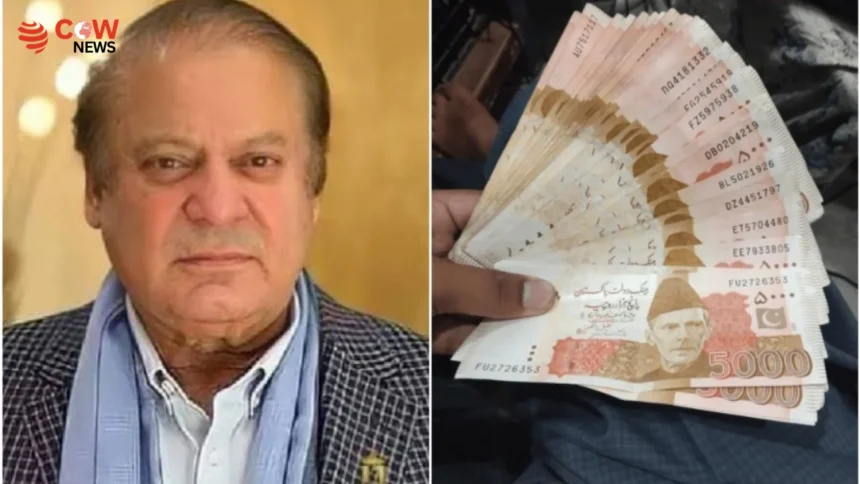
National ( The cow news digital ) A member of the Punjab Assembly from the Pakistan Muslim League-Nawaz (PML-N), Arshad Malik, has sparked political discussion after proposing that former Prime Minister Nawaz Sharif should be featured on Pakistan’s Rs5,000 currency note alongside the country’s founder Muhammad Ali Jinnah.
The statement was made during a session of the Punjab Assembly in Lahore, where the lawmaker urged that national currency should reflect not only the historical founder of the nation but also leaders he credited for contributing to modern development. According to Malik, Nawaz Sharif played a significant role in steering the country toward economic progress and infrastructure development during his time in office.
He argued that including Nawaz Sharif’s image on a high-denomination note would symbolize recognition of what he described as development-oriented leadership. The proposal, however, quickly drew attention due to its political sensitivity, as currency design in Pakistan has traditionally remained closely tied to national identity and state institutions rather than active political figures.
Arshad Malik emphasized that the suggestion was made in the context of acknowledging political contributions to national growth. He reiterated that, in his view, Nawaz Sharif’s policies had helped place Pakistan on a path of economic advancement, particularly through infrastructure projects and energy initiatives launched during his tenure.
The remarks come at a time when political discourse in Pakistan remains highly polarized, with competing parties often engaging in debates over legacy, governance, and national credit for development projects. Critics argue that proposals involving currency design are symbolic decisions that require broad national consensus and institutional approval, rather than being influenced by partisan perspectives.
Currency notes in Pakistan are issued by the State Bank and typically feature the portrait of Muhammad Ali Jinnah, reflecting his central role in the creation of the country. Any alteration to this long-standing tradition would require extensive review and agreement at the federal level.
Political observers note that while such statements often generate public debate, they are unlikely to translate into immediate policy changes. Nevertheless, they highlight the ongoing competition among political leaders to shape public narratives around development and national contribution.
The discussion has also triggered responses on social media, where opinions remain divided between those who view the proposal as symbolic political expression and others who consider it inappropriate for official currency representation.
As of now, no formal proposal regarding changes to currency design has been submitted to relevant authorities, and the suggestion remains a political statement made within the assembly setting.