
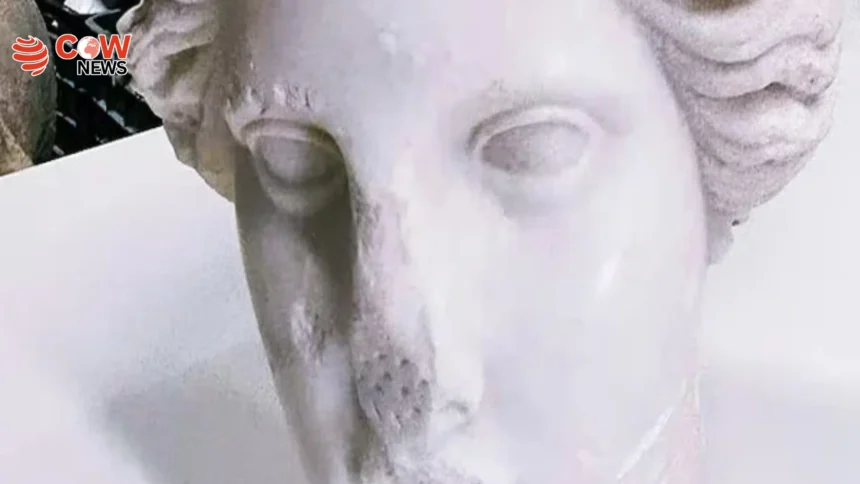
World ( The cow news digital ) Archaeologists in Spain have uncovered a remarkably well-preserved ancient marble sculpture during excavation work at a popular tourist beach, surprising experts with its condition and historical significance.
The discovery was made at Albufereta beach in Alicante, where construction workers came across a marble bust believed to date back nearly 2,000 years to the Roman era.
Initially, workers thought the object was just an ordinary piece of stone. However, upon closer inspection by archaeologists, it was identified as a rare Roman bust, likely originating from the 1st or 2nd century AD.
Experts noted that the sculpture is made of white marble and remains almost fully intact, with only a small portion of the nose showing minor damage. Its preservation has been described as exceptional given its age and exposure to environmental conditions.
Archaeologists believe the find could be one of the most significant Roman-era discoveries in the Alicante region, offering valuable insight into ancient art and cultural presence along Spain’s Mediterranean coast.
Preliminary assessments suggest that the bust may represent a Roman deity, possibly Venus, though further analysis will be required to confirm its exact identity.
The discovery has added to the historical importance of the Albufereta coastal area, which has long been known for its archaeological relevance and Roman-era remains.
Read more
- Pakistan, Taliban, and Afghanistan: The Complex Triangle of Influence
- US Envoy Backs Israel’s Claim to Wider Middle East
Experts say the find could help deepen understanding of Roman settlements and artistic traditions in the region, highlighting Spain’s rich and layered ancient history.
Further excavation work is expected to continue in the area as researchers search for additional artifacts linked to the same historical period.