
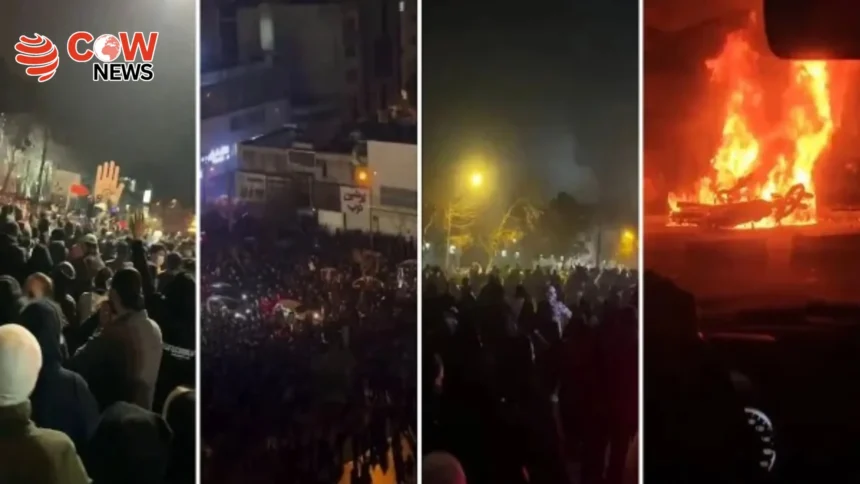
Tehran(The COW News Digital)At least 648 people have been killed during a sweeping crackdown on anti-government protests in Iran, according to an international human rights organization, as demonstrations against the authorities continue for a second consecutive week.
The Norway-based group Iran Human Rights said the death toll was recorded amid intensified security operations aimed at suppressing nationwide unrest. The organization warned that the actual number of casualties could be significantly higher, citing a widespread communications blackout that has made independent verification extremely difficult.
According to the group, Iranian security forces have used force to disperse protesters in multiple cities. Reports indicate the use of live ammunition, mass arrests, and physical violence during crowd control operations. Iranian authorities have not released official casualty figures, while state media has reported substantially lower numbers.
Read More:
- White House Says Military Option Open for Greenland
- UK and France Agree on Troop Deployment for Ukraine
- US Navy Seizes Russian Vessel Evading Venezuela Blockade
The protests, now entering their 14th day, are driven by mounting public anger over economic hardship, currency depreciation, rising inflation, and broader political grievances. Analysts say the rapid decline of Iran’s national currency and worsening living conditions have intensified frustration among large segments of the population.
The situation has drawn international attention, particularly from the United States. President Donald Trump said Washington is closely monitoring developments in Iran and warned that the continuation of protester killings could prompt the US to consider “very tough options.” Trump has previously cautioned Tehran that violent repression of demonstrators would carry serious consequences.
Following Trump’s remarks, Iran’s Supreme Leader Ayatollah Ali Khamenei strongly criticized the United States, accusing Washington of relying on what he described as deceptive tactics and “paid traitors” to destabilize the country. He praised government-backed rallies held across Iran, saying they reflected national unity and resistance to foreign pressure.
Political observers note that President Trump now faces a critical decision on whether to translate his warnings into concrete action. Any potential US response, they argue, could have far-reaching implications not only for Iran but also for regional stability and global geopolitics.
Experts describe the ongoing protests as one of the most serious challenges faced by the Islamic Republic in recent years. While economic factors remain central, analysts say the demonstrations also reflect deeper frustrations with governance, accountability, and political freedoms.
Access to reliable, on-the-ground information remains limited. Major international media outlets, including the BBC, have reported difficulties in conducting independent reporting from within Iran, further complicating efforts to assess the full scale of the unrest and the government’s response.
As tensions continue to rise, the unfolding situation in Iran remains under close watch by the international community.