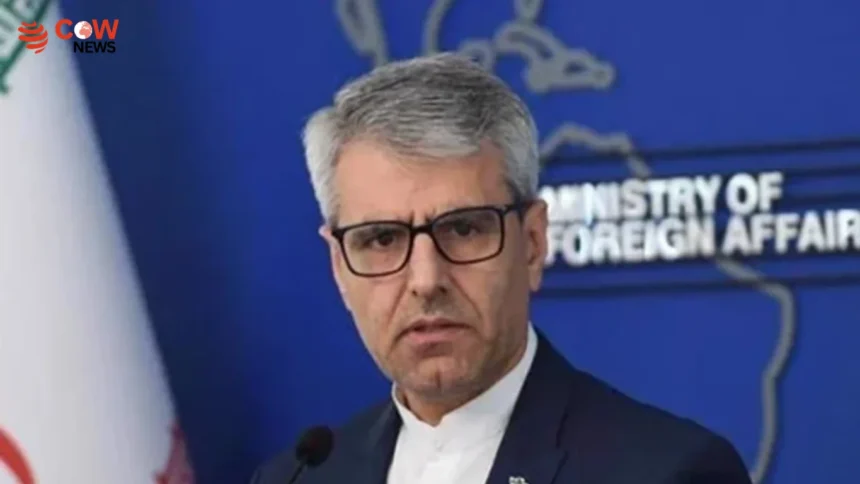
World ( The cow news digital ) Tehran has firmly rejected former U.S. President Donald Trump’s claims about a pending nuclear agreement, stating that no final deal has been reached with the United States. The Iranian Foreign Ministry spokesperson, Esmail Baqai, clarified that reports about the signing date and location of the agreement are purely speculative.
Baqai emphasized that while much of the negotiation draft has been completed, repeated changes in the U.S. position have hindered progress. “The United States’ frequent shifts in stance have affected the pace of talks,” he told reporters, highlighting the cautious approach Iran is taking toward any potential agreement.
Iran has relied on third-party mediation from countries like Qatar and Pakistan, which continue to play a pivotal role in facilitating dialogue. Baqai insisted that Tehran will not compromise on its core principles or red lines, signaling a firm stance on critical national security matters.
This clarification comes in response to Trump’s earlier statements, in which he claimed that the Iran deal had reached its final stages and would soon be signed, potentially at a European venue. Trump also asserted that the Iranian Supreme Leader supported the agreement and that it would prevent Iran from acquiring nuclear weapons.
The conflicting statements from both sides have created uncertainty in international diplomatic circles, raising questions about the timing and feasibility of a finalized accord. Analysts note that while Trump’s announcement was intended to project progress and optimism, Tehran’s rebuttal underscores the complexities inherent in U.S.-Iran negotiations, particularly regarding compliance, verification, and mutual trust.
Read more
- China Urges Global Support for Sustainable Sudan Solution
- US Envoy Backs Israel’s Claim to Wider Middle East
Diplomatic observers highlight that any premature reporting on such sensitive negotiations can complicate the delicate balance between transparency and discretion. As mediators continue their efforts, the international community watches closely, recognizing the potential impact on regional stability, global energy markets, and geopolitical alliances.
Despite the tensions, both nations have emphasized that dialogue continues, leaving room for future progress. Whether the deal eventually materializes remains uncertain, with the recent exchanges revealing the nuanced and often unpredictable nature of high-stakes diplomacy.