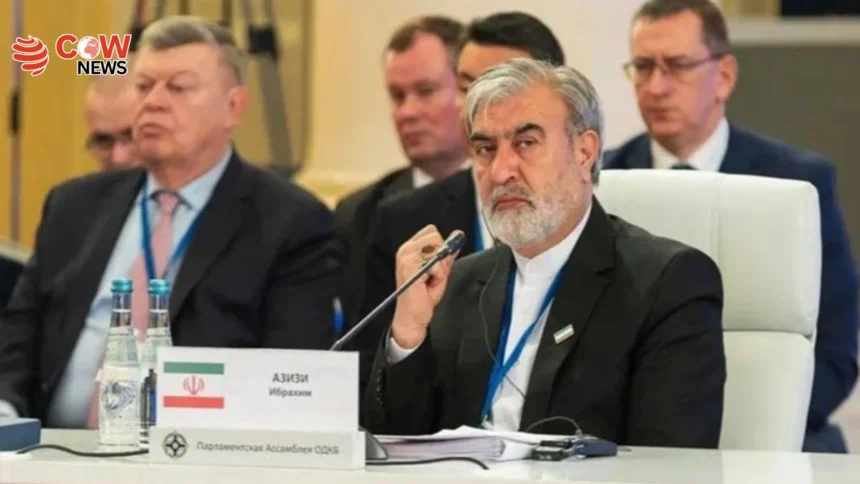
World ( The cow news digital ) Iran has issued a strong warning to the United States, stating that any intervention in the Strait of Hormuz would be considered a violation of ceasefire understandings and could trigger serious regional consequences. The statement came from Iran’s Supreme National Security Council Secretary, Ibrahim Azizi, in response to recent remarks made by former U.S. President Donald Trump regarding maritime operations in the strategic waterway.
Azizi emphasized that the governance and security of the Strait of Hormuz and the Persian Gulf cannot be influenced through what he described as misleading or provocative political statements. He stressed that there is “no space for political rhetoric” when it comes to matters affecting the sovereignty and operational control of one of the world’s most critical shipping routes.
His comments followed Trump’s announcement that the United States would begin efforts to assist in the safe passage of vessels reportedly stranded in the Strait of Hormuz. Trump stated that the initiative, referred to as “Project Freedom,” would focus on ensuring secure transit for non-combatant and neutral commercial ships operating in the region.
According to Trump’s statement, several countries have allegedly requested U.S. assistance to safeguard maritime traffic amid growing instability. He also warned that any obstruction of these operations would be met with a strong response, further escalating concerns over potential confrontation.
The Strait of Hormuz, a narrow but vital maritime corridor, handles a significant portion of the world’s oil transportation. Any disruption in this region is often viewed as a global economic risk, with immediate implications for energy markets and international shipping stability.
read more
- Pakistan, Taliban, and Afghanistan: The Complex Triangle of Influence
- Imran Khan and the Politics of Idolization
Iran, however, has firmly rejected external military or operational involvement in the area, insisting that regional security arrangements must be handled without foreign intervention. Officials in Tehran argue that any unilateral action by external powers could destabilize the already fragile situation in the Gulf region.
Analysts note that the exchange of statements reflects rising diplomatic tension at a time when maritime security in the Arabian Sea and surrounding waters remains highly sensitive. Shipping companies and international stakeholders are closely monitoring developments, as uncertainty continues to impact route planning and insurance costs.
The situation remains fluid, with global attention focused on whether diplomatic channels can prevent further escalation or whether competing strategic interests will deepen regional instability.