
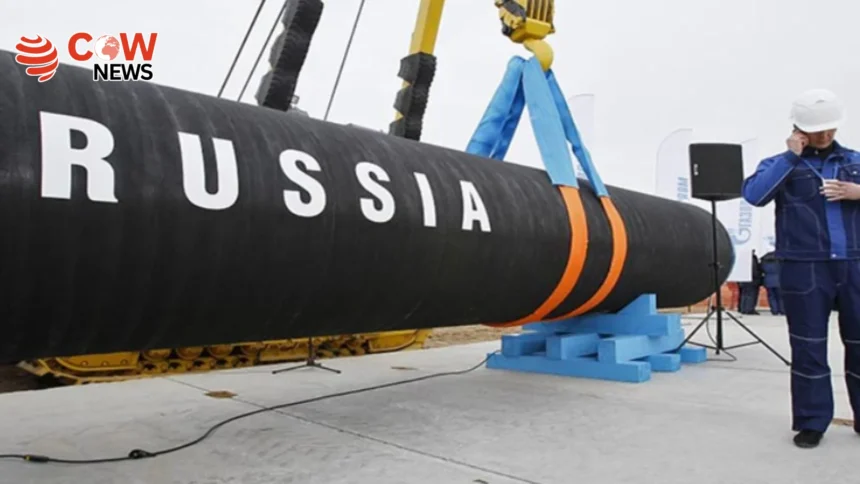
Brussels(The COW News Digital)The European Union has formally approved a landmark decision to stop importing natural gas from Russia starting next year, marking a major shift in the bloc’s energy and geopolitical strategy. According to international news agencies, the ban will come into force on January 1, 2027, as part of the EU’s broader efforts to reduce dependency on Russian energy supplies.
The decision was finalized after extensive deliberations among member states, though it was not without controversy. Countries such as Hungary and Slovakia voiced strong opposition, warning that the move could pose serious challenges to their national energy security and economic stability. Despite these objections, a majority of EU members backed the proposal, emphasizing the need for long-term energy independence and strategic resilience.
Under the approved plan, imports of Russian natural gas through existing contracts will be phased out, while pipeline-based gas purchases will be completely halted by September 30, 2027. EU officials stated that this timeline would allow member states sufficient time to diversify their energy sources and strengthen infrastructure for alternative supplies, including liquefied natural gas (LNG), renewables, and regional energy partnerships.
Read More:
- US Navy Seizes Russian Vessel Evading Venezuela Blockade
- Trump Warns Iran, Says Response Does Not Mean Troop Deployment
European Commission representatives described the decision as a “necessary step” to protect the bloc from geopolitical pressure and supply disruptions. Since the start of the Ukraine conflict, the EU has gradually reduced its reliance on Russian fossil fuels, accelerating investments in renewable energy, energy efficiency, and cross-border energy connectivity.
However, critics argue that the transition may increase energy costs for consumers and industries, particularly in landlocked countries that heavily depend on Russian pipelines. Hungary and Slovakia have repeatedly called for exemptions or extended transition periods, citing limited access to alternative gas routes. EU policymakers acknowledged these concerns and indicated that financial and technical support mechanisms would be considered to assist the most affected member states.
Energy analysts say the decision could have far-reaching implications for global gas markets. As Europe seeks new suppliers, competition for LNG cargoes may intensify, potentially impacting prices worldwide. At the same time, Russia is expected to redirect its gas exports toward Asian markets, reshaping long-established energy trade patterns.
The EU leadership maintains that while the transition will be challenging, it is essential for long-term energy security, climate goals, and political autonomy. The coming years are expected to test Europe’s ability to balance economic stability with strategic independence in an increasingly uncertain global energy landscape.