

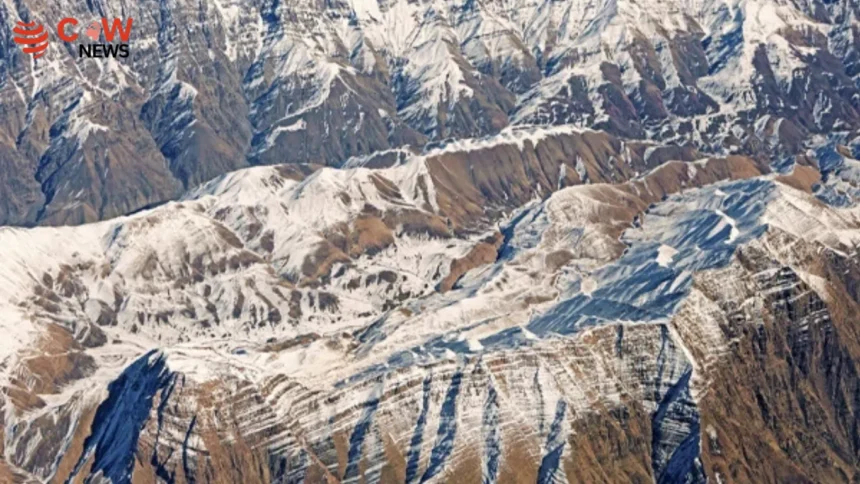
Tehran (The COW News Digital) Scientists have discovered two enormous tears deep within a tectonic plate beneath southeastern Iran, offering new insights into the geological processes that shape continents and influence the movement of Earth’s crust.
The discovery was made by researchers led by scientists from the Chinese Academy of Sciences. Their findings were published in Nature Geoscience .
The study identifies two distinct tears in the Earth’s subducting lithosphere beneath the Zagros–Makran transition zone in southeastern Iran. Scientists believe the structures are linked to the complex interaction between oceanic and continental tectonic plates.
According to the research, part of the Arabian Plate was once associated with the ancient Neo-Tethys Ocean. This region contains dense oceanic rocks, primarily basalt, which are thinner and heavier than continental rocks.
Over millions of years, these oceanic rocks have been pushed beneath another tectonic plate through a process known as subduction.
In contrast, the continental section of the Arabian Plate consists of thicker and comparatively less dense rocks. These rocks resist sinking deep into the Earth’s mantle and instead contribute to the formation of mountain ranges when tectonic plates collide.
Researchers suggest that differences in rock density, thickness and mechanical behaviour have played a significant role in the formation of the newly identified tears.
The research reveals two separate structures with different orientations and geological mechanisms.
The first tear is associated with the transition between the Zagros continental collision zone and the Makran subduction region. Scientists believe it developed as the continental lithosphere encountered resistance while moving deeper into the Earth’s mantle.
The second tear is located near the boundary between the Makran Trench and the Zendan–Minab–Palami fault system. Researchers suggest that it developed due to the continuing movement of tectonic plates and the progressive separation of oceanic and continental lithosphere.
The study indicates that the oceanic lithosphere beneath the Makran region extends to depths of at least 450 kilometres, while the continental lithosphere beneath the Zagros collision zone reaches depths of approximately 300 kilometres or less.
To investigate the Earth’s deep internal structure, researchers analysed seismic data collected through a network of broadband monitoring stations in southeastern Iran.
The seismic observations were recorded between March 2017 and September 2018. By examining how earthquake-generated waves travel through different layers of the Earth, scientists reconstructed images of the tectonic structures beneath the region.
The resulting seismic tomography models provided evidence of the two slab tears and helped researchers understand how the Arabian Plate interacts with the Eurasian Plate.
Scientists say the discovery could improve understanding of how ancient oceans gradually disappear and how continents collide to form mountain belts.
The Neo-Tethys Ocean played a major role in the geological evolution of the region. Its gradual closure contributed to the collision between the Arabian and Eurasian plates and the development of the Zagros mountain range.
Researchers believe the two tears may eventually connect as tectonic movements continue over geological timescales. This could influence mantle flow, tectonic deformation and volcanic activity in the surrounding region.
The findings provide a rare opportunity to observe the transition from oceanic subduction to continental collision, a process that normally unfolds over millions of years.
Although the discovery represents a significant advancement in geoscience, it does not by itself indicate an immediate earthquake threat. The research primarily investigates deep geological structures and long-term tectonic evolution.
The study is expected to help scientists better understand the forces shaping Earth’s interior and the complex history of tectonic plates.