
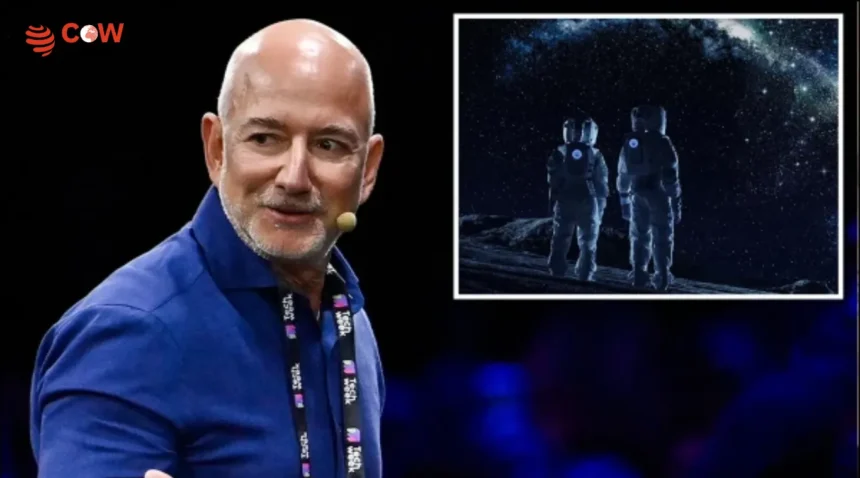
Islamabad (The COW News Digital)Amazon founder and Blue Origin chief Jeff Bezos believes millions of people could be living in space within the next two decades, as advances in space technology open new possibilities for human settlement beyond Earth.
Speaking during a discussion at Italy’s Tech Week 2025, Bezos expressed optimism about humanity’s technological future, suggesting that the coming years could bring significant changes in how people live and work beyond the planet.
According to Bezos, millions of people could be living in space by around 2045. He believes most would choose to settle there out of personal interest and ambition rather than because their presence was essential for carrying out specific tasks.
Bezos also argued that robots could prove more practical and cost-effective than humans for performing difficult operations on the Moon or other celestial bodies. Sending robotic systems to complete challenging work could reduce the expense and logistical difficulties associated with transporting people into space.
His comments come amid growing debate over the future of artificial intelligence, automation and human employment. Addressing concerns that technological progress could eliminate jobs, Bezos argued that inventions have historically contributed to greater prosperity.
He compared modern technological developments with earlier innovations, such as the plough, which helped transform agriculture and improve human productivity. In his view, emerging technologies could similarly create opportunities and improve living standards over time.
Other prominent technology leaders have also expressed optimism about the future of space-based employment and settlement.
OpenAI chief executive Sam Altman has suggested that graduates entering the workforce over the next decade could find exciting, well-paid career opportunities in space. He believes future generations may have access to more interesting professional options than those available to earlier generations at the beginning of their careers.
Tesla and SpaceX chief executive Elon Musk has also championed plans to extend human exploration to other planets. Musk has expressed ambitions for reaching Mars, while SpaceX has pursued the development and testing of rocket systems intended to support future missions. However, the timing of crewed missions and the establishment of permanent settlements remain uncertain.
Dylan Taylor, founder and chief executive of Voyager Technologies, also discussed the prospects for people living and working in space in an interview with Fortune in August 2026. He suggested that this transformation could begin taking shape during the early 2030s.
Despite the optimism surrounding these predictions, establishing large-scale human settlements beyond Earth would require substantial technological advances, significant investment and solutions to major logistical challenges. These include providing reliable life-support systems, protecting people from radiation and ensuring access to food, water and energy.
For now, Bezos’s forecast represents an ambitious vision of humanity’s future rather than a confirmed timeline. Whether millions of people will be living in space by 2045 will depend on how quickly the necessary technologies develop and become economically viable.