
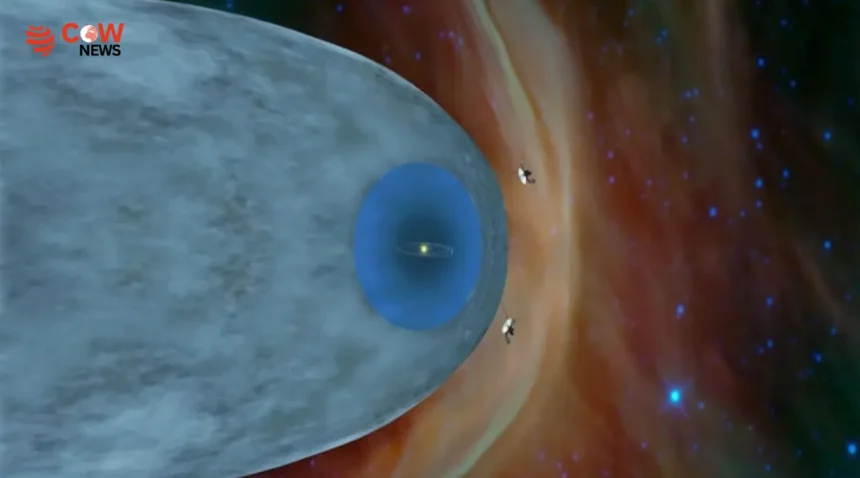
Washington (The COW News Digital) NASA’s Voyager 1 spacecraft is approaching a remarkable milestone in the history of space exploration, as the pioneering probe is expected to reach a distance of one light-day from Earth on November 18, 2026.
Launched nearly half a century ago, Voyager 1 has continued to travel through space, setting records as the most distant human-made object from Earth. Its anticipated achievement will highlight the extraordinary scale of deep-space exploration and the enduring legacy of NASA’s long-running mission.
According to the latest information, scientists expect Voyager 1 to be approximately 25.9 billion kilometres away from Earth on November 18. At that distance, the spacecraft will have reached the equivalent of one light-day.
A light-day is a unit of astronomical distance, referring to the distance light travels in 24 hours. Although light moves at an exceptionally high speed of approximately 300,000 kilometres per second, travelling for an entire day allows it to cover an immense distance.
Voyager 1’s expected position will therefore represent a significant benchmark in its journey away from Earth.
The milestone will also demonstrate how communication with distant spacecraft becomes increasingly challenging as they move farther into the vastness of space.
If a radio signal is transmitted from Earth to Voyager 1 when the spacecraft is approximately one light-day away, the signal will take around 24 hours to reach its destination.
This means that a message sent from mission control will not arrive at the spacecraft immediately. Instead, it will travel through space for an entire day before reaching Voyager 1.
The communication delay will be equally significant in the opposite direction. Once Voyager 1 sends a response or scientific data transmission back towards Earth, the signal will require approximately another 24 hours to complete the journey.
Consequently, a complete communication cycle involving a message sent from Earth and a response received from the spacecraft could take approximately 48 hours.
This extended delay presents a major challenge for spacecraft operations. Commands cannot be delivered instantaneously, and scientists must account for the time required for signals to travel between Earth and the probe.
Voyager 1’s journey has already provided scientists with valuable information about the outer regions of the Solar System and the environment beyond it. Its continued movement into deep space remains a significant achievement in humanity’s efforts to explore the universe.
The spacecraft’s approaching one light-day milestone offers a striking illustration of the distances involved in space travel. It also underlines the technological capabilities required to maintain communication with a probe operating billions of kilometres from its home planet.
As November 18 approaches, Voyager 1 is expected to reach another historic point in its extraordinary journey. The achievement will serve as a reminder of the spacecraft’s remarkable endurance and the lasting impact of NASA’s deep-space exploration programme.