

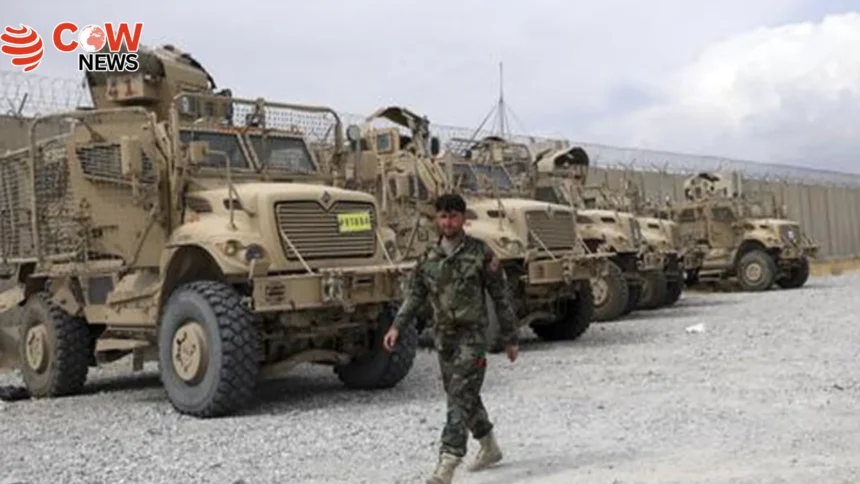
KABUL (The COW News Digital)A recent report by the Special Inspector General for Afghanistan Reconstruction (SIGAR) has revealed that billions of dollars’ worth of U.S. military equipment left in Afghanistan have now become a central component of Taliban security forces. The report, spanning 137 pages, reviewed America’s 20-year mission aimed at rebuilding Afghanistan and training its armed forces.
According to SIGAR, the United States spent approximately $145 billion on Afghan reconstruction between 2002 and 2021. The funds were primarily allocated to establishing a stable, modern security force and supporting a peaceful, democratic government. Despite these efforts, the report concludes that long-term stability and genuine democracy were never realized. Instead, much of the U.S.-supplied equipment strengthened the Taliban following the withdrawal of international forces.
During the exit of U.S. and allied forces, the Department of Defense confirmed that around $710 million worth of military equipment was left behind in Afghanistan. This included tens of thousands of vehicles, over 427,000 small arms, night vision equipment, and more than 160 aircraft. The report stresses that this stockpile has now become a backbone for the Taliban’s security operations across the country.
SIGAR, an independent U.S. agency established in 2008, monitors the expenditure of American taxpayer dollars in Afghanistan to ensure accountability. Its latest findings highlight the unintended consequences of U.S. foreign aid and military support in conflict zones. “The intention was to support Afghan security and governance, but the end result has inadvertently empowered the Taliban,” the report states.
Experts note that the extensive provision of U.S. weapons, training, and logistical support created a security infrastructure that the Taliban quickly absorbed after the U.S. withdrawal. Observers warn that this not only strengthens the group’s operational capabilities but also complicates future international efforts to stabilize the region.
The SIGAR report also sheds light on the broader financial and strategic costs of the U.S. mission, noting that while billions were spent on military and civilian reconstruction projects, significant portions of the investment failed to produce sustainable outcomes.
The findings have sparked debate in Washington about accountability, the effectiveness of long-term military interventions, and the need for stricter oversight when providing military assistance in conflict zones.
This revelation underscores the challenges of nation-building efforts and the risks of leaving high-value military assets in unstable regions.