

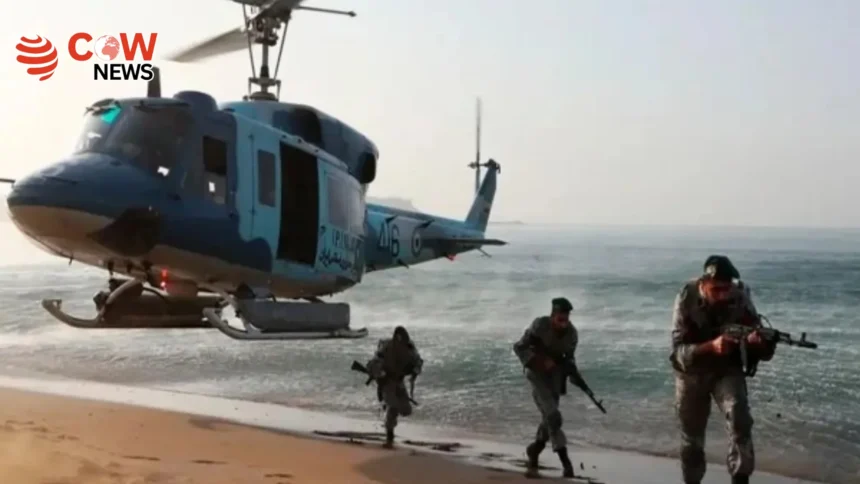
Iran(The COW News Digital) Iran has announced the start of live-fire military exercises in the airspace near the Strait of Hormuz, one of the world’s most critical maritime chokepoints, issuing a formal Notice to Air Missions (NOTAM) that places restrictions on flights in the area.
According to official Iranian notifications, the drills will take place from January 27 to January 29 within a five-nautical-mile radius. The exercises will cover airspace extending from ground level up to an altitude of 25,000 feet. During this period, the designated airspace has been declared hazardous, and civilian flight operations will remain limited.
The announcement comes at a sensitive time, as United States military assets have reportedly arrived in the Middle East, adding to already heightened tensions in the region. Analysts say the timing of the drills is likely to be closely monitored by global powers, particularly those with strategic and economic interests tied to the Gulf.
Read More:
- US Navy Seizes Russian Vessel Evading Venezuela Blockade
- Maria B Makes History with Grand Debut in Bangladesh
- UK and France Agree on Troop Deployment for Ukraine
The Strait of Hormuz holds immense geopolitical and economic significance. It serves as a narrow maritime passage connecting the Persian Gulf with the Arabian Sea and is a key route for global energy supplies. Millions of barrels of crude oil and petroleum products pass through the strait every day, making any military activity in or around the area a matter of international concern.
Iran has previously used military exercises in the region to signal its defensive readiness and assert control over its surrounding waters and airspace. While Iranian authorities have not directly linked the drills to recent developments involving foreign military movements, regional observers believe the exercises send a clear message amid escalating security dynamics.
Airlines operating in the Gulf region are expected to closely follow the advisories issued by aviation authorities. In past instances, similar NOTAMs have prompted carriers to reroute flights to avoid potential risks, increasing travel time and operational costs.
The situation underscores the fragile security environment in the Middle East, where military maneuvers by regional and international actors often carry broader strategic implications. Any disruption in the Strait of Hormuz could have immediate consequences for global oil markets and international trade.
As the drills continue over the coming days, diplomatic circles and defense analysts will be watching closely for further developments, including any response from the United States or neighboring Gulf states.