

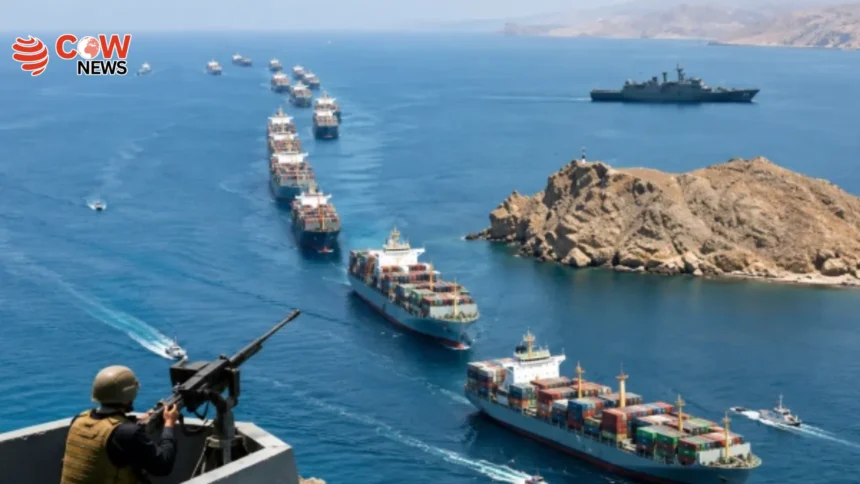
World ( The cow news digital ) Iran’s Islamic Revolutionary Guard Corps (IRGC) has claimed that 26 commercial vessels were assisted in navigating through the Strait of Hormuz over the past 24 hours under its supervision and approval.
According to Iranian state media, the IRGC stated that all ships transiting the strategically vital waterway were required to establish contact with Iranian naval authorities before being granted permission to proceed. The statement emphasized that maritime movement in the region is being closely monitored and coordinated with Iranian naval forces.
The IRGC further asserted that no vessel is allowed to pass through designated zones without prior authorization, reinforcing Tehran’s control over parts of the maritime corridor. Iranian authorities have also reportedly issued a new maritime map, designating certain areas within the Strait of Hormuz as “controlled maritime zones,” where passage is subject to clearance procedures.
These controlled areas are said to extend from regions near Kuh-e Mobarak to the southern waters of Fujairah, as well as from Qeshm Island to the vicinity of Umm Al Quwain. Iranian officials argue that these measures are intended to regulate maritime traffic and ensure security in a highly sensitive shipping lane.
The Strait of Hormuz is widely regarded as one of the most critical energy chokepoints in the world, with an estimated 20 percent of global oil exports passing through it. Any disruption in this route has historically had significant implications for global energy markets, often leading to fluctuations in oil prices and heightened geopolitical tensions.
The latest developments come amid ongoing regional tensions involving Iran, the United States, and Israel. Earlier escalations have already led to increased security measures in the Gulf region, with maritime operations under heightened surveillance.
Analysts note that any tightening of control over the Strait could further impact global shipping costs and energy supply chains, particularly if restrictions or inspections become more frequent or politically driven.
Read more
- China Urges Global Support for Sustainable Sudan Solution
- Trump Hopes Iran Talks Succeed, Warns Against Midnight Hammer
Iran has previously stated that its actions are aimed at safeguarding national security and maintaining order in its territorial waters, while critics argue that such measures could complicate international navigation and trade.
The situation remains fluid, with international shipping operators closely monitoring developments in the region for any potential risks or changes in maritime regulations.