
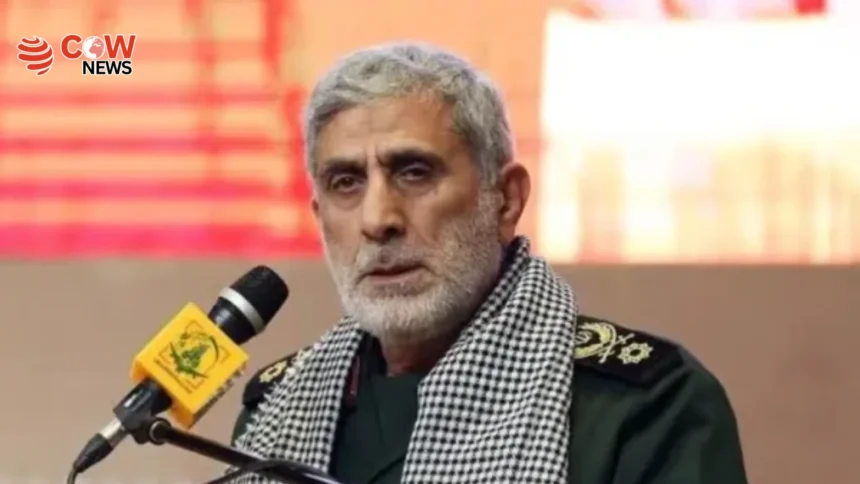
World ( The cow news digital ) The commander of Iran’s Islamic Revolutionary Guard Corps Quds Force, Brigadier General Ismail Qaani, has issued a strong warning to the United States and Israel amid rising tensions in the Middle East, stating that any act of aggression will be met with resistance and that adversaries will ultimately be forced to retreat.
In a recent statement, Qaani said that resistance movements across the region are fully active, organized, and more prepared than ever to respond to any potential military escalation. He emphasized that these groups are closely coordinated and remain on high alert in the face of evolving regional developments.
He further stated that the United States and Israel should learn from past experiences, referring to conflicts in areas such as Yemen, the Bab al-Mandab Strait, and the Red Sea, where he claimed that opposing forces have failed to achieve their strategic objectives.
According to Qaani, any future attempts at military action would also fail to produce results, as regional resistance networks are now stronger and more capable of countering external pressure. He asserted that these groups would disrupt and neutralize any plans aimed at destabilizing the region.
The comments come at a time of heightened geopolitical tension, with multiple reports suggesting increased military activity and strategic positioning in key maritime and regional zones. Analysts say such statements reflect growing uncertainty and the potential for further escalation if diplomatic channels do not gain momentum.
Meanwhile, reports from international monitoring sources indicate increased naval and security operations in sensitive waterways, raising concerns over maritime stability and global trade routes. Some officials have warned that vessels violating security directives in these regions could face interception or detention.
read more
Security analysts caution that the current situation could have wider implications for global energy markets and international shipping lanes if tensions continue to rise. They also stress that diplomatic engagement remains critical to preventing further escalation.
The situation remains fluid, with regional and global actors closely watching developments as diplomatic and military dynamics continue to evolve.