
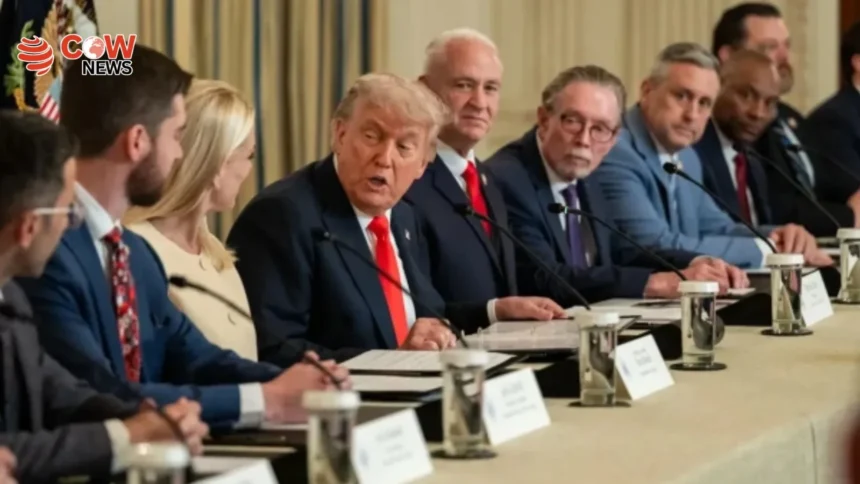
Washington(The COW News Digital)U.S. President Donald Trump defended recent military actions against Iran during a roundtable discussion, asserting that without American intervention, Iran would have been capable of producing nuclear weapons within two weeks. Speaking on the matter, Trump emphasized the necessity of decisive action to curb Iran’s nuclear ambitions.
President Trump highlighted the strengthening of U.S. armed forces since taking office, expressing pride in the military’s performance. He described the operations against Iran as a demonstration of American power, citing the destruction of Iranian missile launchers and other strategic assets as evidence of the effectiveness of the campaign.
In his remarks, Trump criticized former President Barack Obama’s nuclear deal with Iran, labeling it the “worst” agreement and noting that he had officially ended the deal four years ago. He argued that the recent strikes have set back Iran’s nuclear program significantly, positioning the United States in a more dominant and secure stance in the region.
read more
- Pakistan, Taliban, and Afghanistan: The Complex Triangle of Influence
- China Urges Global Support for Sustainable Sudan Solution
The president’s comments underscore the administration’s continued focus on limiting Iran’s nuclear capabilities while asserting U.S. military superiority. By emphasizing the imminent threat of Iran’s nuclear development, Trump framed the actions as preventive measures necessary for national security.
Experts note that Trump’s statements reflect a broader strategy of deterrence, aimed at sending a strong message to Iran and other regional actors regarding the consequences of pursuing nuclear weapons. While the administration maintains that the operations were targeted and measured, the rhetoric also highlights tensions between the U.S. and Iran, which have intensified in recent months.
The remarks are likely to influence ongoing international debates about the Middle East, nuclear non-proliferation, and the role of U.S. military interventions. Global observers are closely monitoring the situation, weighing the implications of the strikes for regional stability and the potential for escalation.
As the United States continues to assert its position on Iran’s nuclear program, the conflict remains a central focus of both domestic and international political discourse, highlighting the delicate balance between military action, diplomacy, and global security concerns.