
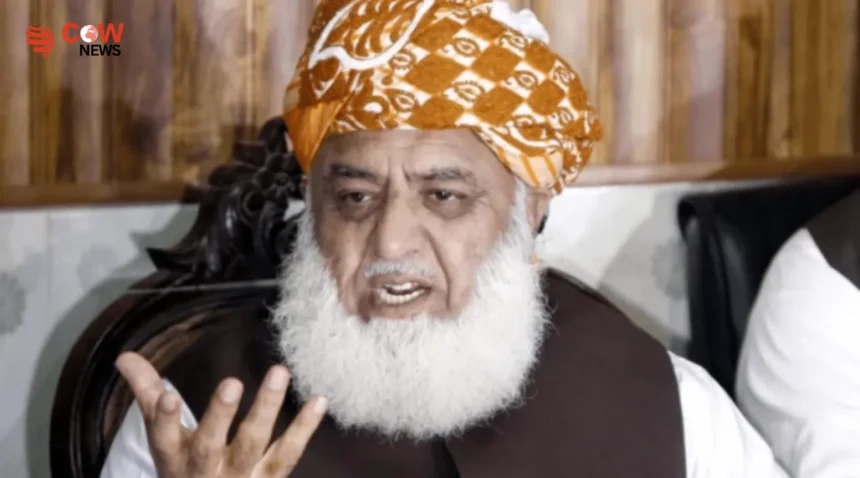
Peshawar (The COW News Digital) Jamiat Ulema-e-Islam (F) chief Maulana Fazlur Rehman has warned that Pakistan’s tribal districts are once again being turned into an “experimental ground,” arguing that the real issue in the region concerns its valuable mineral resources rather than constitutional arrangements.
Addressing the Digital Media Workers JUI FATA Convention in Peshawar, Fazlur Rehman questioned the growing discussion about reversing the merger of the former Federally Administered Tribal Areas (FATA) with Khyber Pakhtunkhwa. He said nearly a decade had passed since the merger, yet the tribal districts had still not been provided with an administrative system comparable to settled areas.
The JUI-F chief said he had been told at higher levels that the merger decision was incorrect. He questioned who had originally approved the merger and why its reversal was now being discussed, suggesting that the public deserved clarity about the decision-making process.
Fazlur Rehman said he had repeatedly highlighted the issue of mineral resources in the tribal areas, even before discussions about imposing governor’s rule and emergency measures.
He stated that his party had no objection to mineral exploration or development. However, he insisted that agreements concerning the region’s natural resources must be made public.
The JUI-F leader claimed that valuable gemstones had been presented in offices of US officials and alleged that American authorities had acknowledged moving forward on the matter.
He called for transparency in resource-related agreements, saying the tribal population should be informed about decisions involving their land and mineral wealth.
“We have resources, while you have technology,” he said, urging authorities to engage openly with the public and disclose the terms of any agreements.
Fazlur Rehman also criticised the imposition of governor’s rule and emergency measures, questioning the justification for creating different administrative systems within the same province.
He said the measures had been introduced on the basis of concerns over terrorism, but claimed that public discussion about terrorism had subsided following their implementation.
According to him, the Governor’s Council operating under governor’s rule is subordinate to the prime minister, while districts covered by emergency measures fall under the Ministry of Interior.
He further claimed that preparations were underway to include Kohat among the districts placed under emergency arrangements.
The JUI-F chief said cabinet decisions had been forwarded to the president, but alleged that his position was not presented during the cabinet meeting on the day the measures were introduced.
He questioned how public confidence in the state and its institutions could be maintained under such circumstances, urging authorities to address the concerns of tribal residents.
Discussing the political atmosphere, Fazlur Rehman criticised campaigns involving allegations and personal attacks against political opponents. He said his party believed in dialogue and urged political leaders to resolve disagreements through discussion rather than character assassination.
He also commented on Defence Minister Khawaja Asif, describing him as a respected elder brother. Fazlur Rehman said he had made a light-hearted remark towards Asif, but the minister had reacted angrily the following day.
In a sarcastic response, he suggested that Asif should have directed his anger towards himself, adding that the PML-N had already responded to him in parliament.
Fazlur Rehman said his party had exercised restraint but was also capable of responding when necessary.
He also responded to the governor’s suggestion that he should travel to Afghanistan, making a historical reference to British rule and saying that those who had been under British authority should consider going to Britain themselves.
Fazlur Rehman reiterated his desire for a healthier political environment in the country. He said negotiations had previously been suggested by the prime minister as a way to resolve issues surrounding a long march.
He added that a similar proposal had been presented to Pakistan Tehreek-e-Insaf (PTI), which had also expressed its position on the matter.
The JUI-F leader concluded that national development and prosperity depended on addressing the concerns of tribal residents and ensuring that they were properly consulted over the region’s resources.