
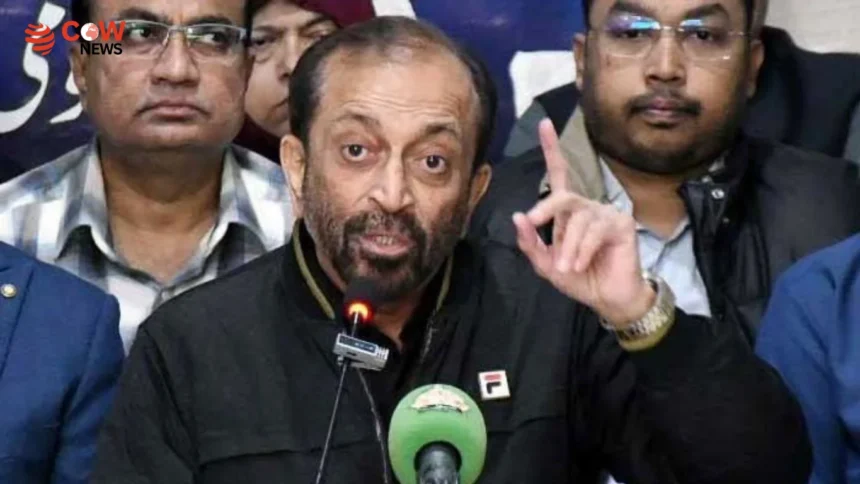
National ( The cow news digital ) Senior leader of the Muttahida Qaumi Movement Pakistan, Farooq Sattar, has issued a strong warning to the federal government, stating that his party will escalate its political response if key demands remain unaddressed, including the issue of missing persons, the governorship of Sindh, and implementation of local governance reforms.
Speaking at a press conference, Farooq Sattar said the party would soon send a formal letter to the Speaker of the National Assembly if its concerns are not resolved. He added that the party may request seating arrangements for its 22 lawmakers on the opposition benches as part of its protest strategy.
He reiterated that the 2022 agreement between the Pakistan Peoples Party and MQM Pakistan remains unimplemented. According to him, the agreement was signed by PPP Chairman Bilawal Bhutto Zardari and was also witnessed and guaranteed by Prime Minister Shehbaz Sharif. Calling it a “final warning,” he urged the prime minister to ensure the agreement is implemented in letter and spirit.
Among the key demands outlined by MQM Pakistan are the resolution of missing persons cases, enforcement of Article 140-A related to local government empowerment, establishment of an administrative unit in Karachi, and the appointment or removal process regarding the Sindh governorship. Sattar also stressed the need for an urban development package for Karachi, arguing that the city’s governance structure requires urgent attention.
He further claimed that the Pakistan Peoples Party had stated it was not involved in any decision regarding the removal of the Sindh governor, and called on the federal government to provide clarity on the matter.
In response, Sindh’s senior minister Sharjeel Inam Memon criticized MQM Pakistan’s stance, describing the press conference as political pressure tactics. He accused the party of losing public trust and attempting to regain influence through what he termed “shortcuts” and political bargaining.
Read more
- Pakistan, Taliban, and Afghanistan: The Complex Triangle of Influence
- China Urges Global Support for Sustainable Sudan Solution
Memon added that attempts to place Sindh’s administrative matters under federal control were against the constitutional framework and amounted to undermining provincial autonomy. He maintained that the people of Sindh had already given a clear mandate to the PPP, which could not be altered through political statements or pressure tactics.
The exchange highlights ongoing tensions between MQM Pakistan and the Sindh government, reflecting deeper disagreements over governance, urban development, and constitutional authority in the province.