

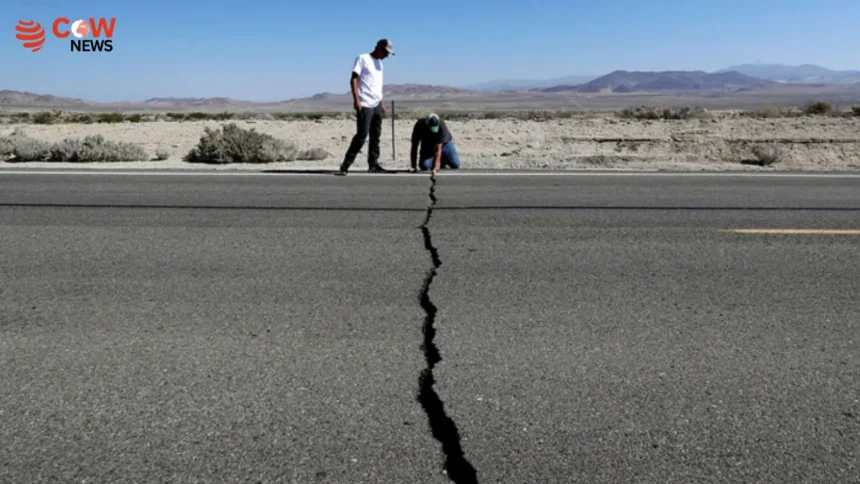
National ( The cow news digital ) Seismic activity across various regions of Pakistan has raised concerns after multiple moderate earthquakes were recorded within a short span of time, with experts suggesting a possible connection to recent powerful earthquakes in Venezuela. According to the Chief Meteorologist, energy waves generated by the South American seismic events may be influencing tectonic activity in parts of South and Central Asia.
Pakistan has experienced at least six moderate earthquakes since yesterday, affecting Islamabad, Punjab, Khyber Pakhtunkhwa, Gilgit-Baltistan, and Azad Jammu and Kashmir. The strongest tremors were recorded at a magnitude of 5.9 with a depth of 178 kilometers, originating from the Hindu Kush region in Afghanistan, according to seismic monitoring authorities. The tremors were felt at approximately 6:35 PM, causing alarm among residents across several cities.
Earlier the same day, another earthquake struck the Kohlu region of Balochistan, where officials reported a magnitude of 5.2. The epicenter was identified near Barkhan. Additional tremors were also felt in Multan and surrounding areas, although they lasted only a few seconds.
Chief Meteorologist Amir Haider Laghari stated that Balochistan has experienced a continuing series of seismic events since the previous day, with at least five moderate earthquakes recorded in the region. He explained that these activities are occurring along the Eurasian tectonic plate, which covers large parts of Pakistan, making the region naturally prone to seismic disturbances.
In an unusual scientific explanation, some geoscientists have suggested that the recent global seismic chain reaction could be linked to major earthquakes in Venezuela, where powerful tremors of magnitude 7.2 and 7.5 were recorded earlier this week. These quakes reportedly caused extensive infrastructure damage, with hundreds of casualties and thousands of injuries.
According to these views, underground energy waves generated by the Venezuelan earthquakes may have traveled across interconnected tectonic plates, triggering secondary seismic activity in distant regions such as Pakistan. However, experts emphasize that while such theories are being discussed, earthquake prediction and precise causal linking remain scientifically uncertain.
Geologists note that Pakistan lies on a highly active seismic zone due to the collision between the Eurasian and Indian tectonic plates, making earthquakes a recurring natural hazard independent of distant seismic events.
Read More
- Pakistan, Taliban, and Afghanistan: The Complex Triangle of Influence
- US Envoy Backs Israel’s Claim to Wider Middle East
Historical comparisons have also been drawn with the early 2000s, when a series of global earthquakes was followed by major seismic activity in the Himalayan region, including the devastating 2005 Kashmir earthquake.
Authorities continue to monitor the situation closely, urging the public to remain cautious as aftershocks or further moderate tremors may still occur. Scientists stress that while patterns can be studied, the exact timing and intensity of earthquakes cannot be reliably predicted.